
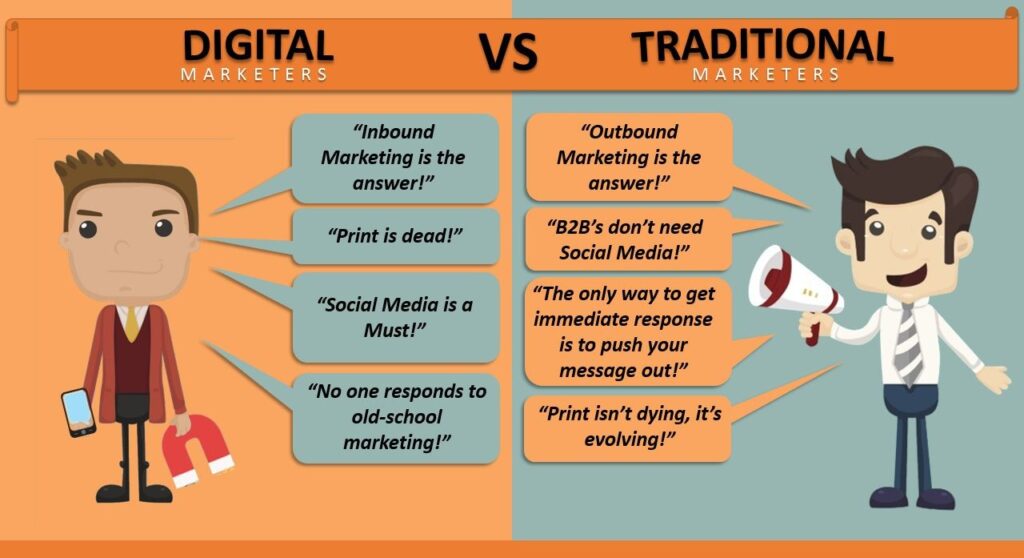
Traditional Marketing vs Online Marketing: The Definitive Guide for Your Business
The modern business landscape presents a central challenge. A business owner with a limited budget wonders if they should invest in hoardings or Google Ads. A marketing student asks which approach is more relevant for today’s job market. And a startup founder needs to know which method offers the most scalable and ROI-focused path to success.
This is a strategic puzzle.
It is the core conflict between two powerful forces: traditional marketing and online marketing. The debate surrounding Traditional Marketing vs Online Marketing is not about which is superior, but how to use the right tool for the right job.
This guide will provide a clear, data-backed roadmap. It will move beyond simple definitions to offer practical advice for a wide range of needs and goals, offering a definitive look at Traditional Marketing vs Online Marketing.
What is Traditional Marketing? The Tried and True Approach
Traditional marketing is any promotional method that operates without the internet or digital technology [1]. These are the original, proven ways to get a brand into the world [2]. While digital channels have captured the spotlight, traditional methods have maintained their relevance.
Why? Because they offer something unique: tangibility.
Traditional materials, from a newspaper ad to a business card, have a physical presence [3, 4]. This tangibility creates a physical connection with a brand, which can build a higher level of trustworthiness [5, 6]. Print media, for instance, is trusted by 82% of people [7]. Traditional marketing is a critical tool for building long-term brand recognition and trust.
The Classic Channels
- Print Advertising: Appears in newspapers, magazines, and local publications [8].
- Broadcast Advertising: Includes television and radio. U.S. adults spend an average of 3 hours per day watching traditional TV [7].
- Out-of-Home (OOH) Advertising: Public space marketing like billboards.
- Direct Mail & Handouts: Direct mail boasts a response rate 5 to 9 times greater than that of email or paid search [3].
What is Online Marketing? The Modern Evolution
Online marketing is the use of digital channels—such as websites, social media, and search engines—to promote and sell products [9]. Today, consumers spend nearly 7 hours daily online [10], making digital marketing an essential component of any strategy.
The shift from Traditional Marketing vs Online Marketing represents a fundamental change: traditional is passive and one-way, while digital is an interactive, two-way conversation [6, 11]. It allows for real-time engagement and feedback [11].
The Digital Marketing Toolkit
- Search Engine Optimization (SEO): Optimizing a website to appear higher in search results [12, 13]. SEO delivers a remarkable 22:1 return on investment (ROI) [10].
- Social Media Marketing: Allows businesses to find, engage with, and build relationships within a community [12].
- Paid Advertising (PPC/Display Ads): Google Ads typically return $2 for every dollar spent [10].
- Email Marketing: Offers an exceptional average ROI of 42:1 [10].
The Ultimate Showdown: Key Differences at a Glance
For a business owner, the strategic choice boils down to the core differences between Traditional Marketing vs Online Marketing.
Cost, ROI & Measurability: Following the Money Trail
Traditional marketing requires a high, fixed upfront investment. A single national newspaper ad can start at over $1,000 [16]. Digital marketing, by contrast, has lower, more scalable entry costs. A new Google Ads campaign can begin with a budget of just $20 to $50 per day [17]. The conflict between Traditional Marketing vs Online Marketing is clearest in measurability: digital offers real-time data [10, 15], while traditional is often a “spray and pray” approach [3].
| Characteristic | Traditional Marketing | Online Marketing |
| Cost | Significant upfront investment. | Lower entry costs, highly scalable. |
| ROI | Difficult to track. (TV: $4.20 return per dollar [10]) | High, measurable returns. (Email: 42:1, SEO: 22:1 [10]) |
| Targeting | Broad and less granular [6]. | Highly precise (demographics, interests, behavior) [1]. |
| Measurement | Difficult to measure accurately [3, 6]. | Provides granular, real-time analytics [11, 15]. |
| Reach | Massive reach for broad, local audiences [7]. | Global reach, but also allows for hyperlocal targeting [18]. |
Export to Sheets
Reach & Targeting: Hitting the Mark
Traditional marketing has a massive reach for a broad, often local audience [6, 7]. Digital marketing can be both global and hyperlocal [11]. Local SEO and geotargeted ads can pinpoint a local audience with extreme precision [14, 18]. The precision of online is a key factor when comparing Traditional Marketing vs Online Marketing.
The Pros and Cons: A Balanced View
Why Traditional Marketing Still Wins
- Tangibility & Brand Legitimacy: Physical materials create a longer-lasting impression [6].
- Mass Awareness: Ideal for reaching a large, broad audience [7].
- Local Market Penetration: Effective for local and older demographics [1].
Why Digital Marketing is the Future
- Superior ROI & Cost-Effectiveness: Low entry cost and high ROI [10].
- Data-Driven & Flexible: Campaigns can be tracked, measured, and optimized in real-time [15].
- Personalization & Global Reach: Personalized messages for segments [3] with global power [11].
However, the technical complexity and dependence on ever-changing algorithms are disadvantages of digital when considering Traditional Marketing vs Online Marketing.
The Big Question: Which One is Right for You?
The answer to the question of Traditional Marketing vs Online Marketing depends entirely on the goals and resources of a business.
Practical Advice for Every Persona
- Small Business Owner: Start with a digital-first approach. Focus on local SEO [14] and email marketing (42:1 ROI [10]). For traditional, use low-cost, targeted methods like local flyers [8].
- Marketing Student & Beginner: Focus on foundational digital skills: SEO & SEM, data analysis, and content creation [19, 20].
- Entrepreneur & Startup: Prioritize scalable, data-driven channels. A budget allocation of roughly 60–70% to digital and 30–40% to traditional is suggested [10]. The strategic blend is the key differentiator in Traditional Marketing vs Online Marketing today.
The Smartest Strategy: Don’t Choose, Combine!
The most effective marketing strategy today does not pit Traditional Marketing vs Online Marketing. It seamlessly integrates them [23, 24]. Traditional marketing builds brand recognition and credibility, while digital drives targeted action [23]. This combination creates a more seamless customer journey [23].
How to Build a Powerful Hybrid Plan
The core principle is using data from one channel to inform the strategy of the other [25].
- QR Codes: Place QR codes on print ads and billboards to bridge offline and online engagement [23]. This is a simple, effective solution in the Traditional Marketing vs Online Marketing debate.
- Geotargeting Billboards: Deliver digital ads to people near a physical billboard [26].
- Repurpose Content: Edit a TV commercial into short clips for social media [26].
Real-World Wins: Integrated Success
The debate of Traditional Marketing vs Online Marketing is best settled by integrated campaigns.
- Coca-Cola’s “Share a Coke” Campaign: Began with a traditional, physical product (the named bottle) which became the catalyst for a digital, user-generated content campaign on social media [28, 31].
- Old Spice’s “The Man Your Man Could Smell Like” Campaign: Combined a memorable TV commercial with a rapid-response digital strategy, creating personalized video responses to social media comments [28, 31].
Final Verdict: Your Path to Growth
For too long, businesses have been forced to choose between Traditional Marketing vs Online Marketing. The reality is that this is no longer a choice a business should have to make.
A modern, effective strategy uses both.
The greatest success comes from the synergy between these two approaches. By leveraging the trust and mass awareness of traditional channels while simultaneously harnessing the data-driven precision and flexibility of digital, a business can create a powerful and resilient marketing engine. The comparison of Traditional Marketing vs Online Marketing ultimately leads to a unified, hybrid approach for maximum growth. Sources

Tools
Gemini can make mistakes, so double-check it chrome-extension://kdfieneakcjfaiglcfcgkidlkmlijjnh/writer/index.htmlTo approve a single suggestion, mouse over it and click on suggestionClick here to accept all suggestions in the sentence
Google Account
Meet Patoliya
meetpatoliya177@gmail.comEnable GingerCannot connect to Ginger Check your internet connection
or reload the browserDisable Ginger?How to use GingerRephraseRephrase with Ginger (Ctrl+Alt+E)0Log in to edit with GingerGinger is checking your text for mistakes…Disable Ginger in this text fieldDisable Ginger on this website
600/17158 free characters checked.
Go Premium to check longer texts and entire documents
Add files
Use microphone
Search (Ctrl+Shift+K)
Expand menu
Storybook
Explore Gems
Blog Outline: Traditional vs. Online Marketing
Traditional vs. Online Marketing Explained
Image Upload Issue, Product Creation
Recreate the Instagram post style shown in the reference concept. Place the Shyamosa Hair All-in-One bottle (as shown in…
ChatGPT Guide: Plan & Outline
Understanding Google Panda Algorithm
Figurine Creation From Photo
Laptop Recommendation With Specific Criteria
Laptop Search for Retirement
Instagram Hashtag Suggestions
Digital Marketer’s Professional Bio
SEO Titles For Digital Marketing
Raksha Bandhan Marketing Caption
Edit prompt
Expand text
Traditional vs. Online Marketing Guide
Copy response
More/_/bscframe